
You Don’t Need the Title to Lead
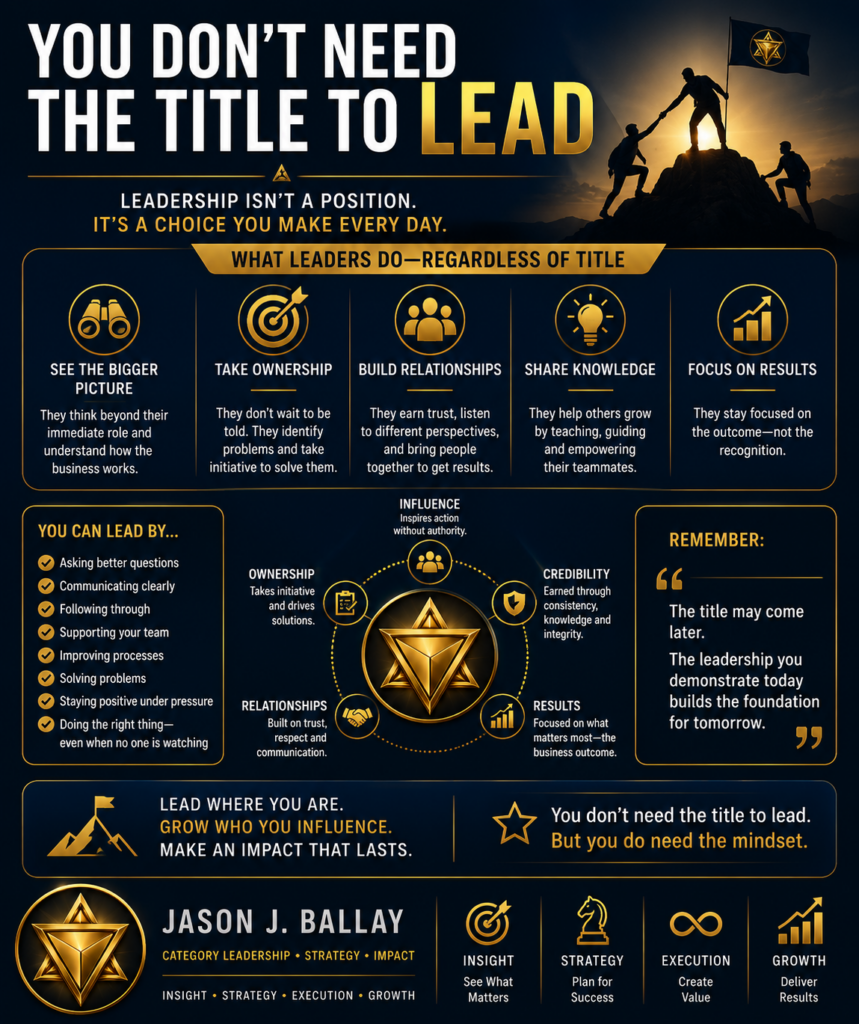
By Jason J. Ballay
For a long time, I think many of us associated leadership with a title.
Manager. Director. Vice President.
Those titles certainly come with authority and responsibility. But after years of working across category management, purchasing, wholesale distribution, manufacturer partnerships, and cross-functional teams, I’ve come to believe something different:
Leadership often starts long before the title arrives.
Some of the best examples of leadership I’ve seen haven’t involved someone telling people what to do. They’ve involved someone recognizing a problem, taking ownership, bringing the right people together, and helping move everyone toward a solution.
That’s leadership through influence.
Authority and Influence Are Not the Same Thing
A title can give you authority.
It doesn’t automatically give you influence.
Influence is earned through credibility, relationships, knowledge, consistency, and the ability to help people solve problems.
This becomes especially important in roles such as category management.
A Category Manager may need cooperation from purchasing, sales, operations, IT, marketing, warehouse teams, manufacturers, and customers.
Most of those people don’t report to the Category Manager.
You can’t simply tell everyone what to do.
You have to explain the problem, demonstrate why it matters, understand different perspectives, and help people see how working together creates a better outcome.
That requires a different kind of leadership.
Start With the Problem, Not the Authority
One of the most valuable lessons I’ve learned is that when something needs to change, asking “Who has the authority?” isn’t always the most productive first question.
Sometimes the better questions are:
What’s preventing us from getting the result we need?
Who needs to be involved?
What information are we missing?
How can I make it easier for everyone to move forward?
That mindset changes your role.
Instead of waiting for someone else to solve the problem, you become part of creating the solution.
You may not make the final decision.
You may not supervise everyone involved.
But you can still help create momentum.
Leadership Can Look Like Problem Solving
Leadership isn’t always standing in front of a room giving directions.
Sometimes leadership is noticing a recurring problem that everyone has learned to live with and asking:
Why are we still doing it this way?
Sometimes it’s developing a better process.
Sometimes it’s sharing information between departments that weren’t communicating effectively.
Sometimes it’s helping a colleague understand something you’ve already learned.
Sometimes it’s bringing several people together around a common objective.
And sometimes it’s simply taking responsibility when it would be easier to say:
“That’s not my department.”
Those moments may never appear on an organizational chart.
But they influence results.
Relationships Matter
Influence becomes much easier when people trust you.
That trust isn’t built during one meeting.
It’s built over time.
It’s answering the phone when someone needs help.
It’s following through on commitments.
It’s sharing information instead of protecting it.
It’s understanding that a supplier, salesperson, buyer, warehouse employee, customer, and executive may all look at the same problem differently.
Strong leaders learn to understand those perspectives.
You don’t always have to agree.
But understanding what matters to other people makes it much easier to find solutions that work.
Help Other People Become Better
Another form of leadership that doesn’t require a title is developing other people.
If you’ve spent years learning something, share it.
Help the new employee avoid mistakes you made.
Explain why a process works instead of simply showing someone which buttons to push.
Give someone an opportunity to solve the problem before providing the answer.
Leadership isn’t about making yourself indispensable.
It’s about helping the people around you become more capable.
And sometimes one of the clearest signs that you’ve influenced someone is watching them eventually teach the same lesson to somebody else.
Learn to Lead Across Functions
Modern businesses are increasingly interconnected.
A supply problem can become a sales problem.
A regulatory change can become an inventory problem.
An inventory problem can become a customer problem.
A customer problem can become a financial problem.
That’s why leadership can’t always stay inside departmental boundaries.
The people who create value are often the ones who can connect those dots.
They understand how one decision affects another part of the organization.
They communicate across functions.
They bring people together.
And they focus on the business outcome rather than protecting departmental territory.
Don’t Wait for Permission to Become a Leader
There is an important distinction here.
Leading without authority does not mean ignoring organizational structure or making decisions that aren’t yours to make.
It means taking ownership of what is within your control.
You can ask better questions.
You can identify opportunities.
You can develop solutions.
You can communicate more effectively.
You can mentor others.
You can build stronger relationships.
You can become someone people trust when problems arise.
None of those things require a promotion.
The Title Should Recognize the Leadership
I’ve come to believe that one of the best ways to prepare for leadership opportunities is to begin practicing leadership before receiving the position.
Don’t pretend to have authority you don’t have.
Instead, demonstrate the behaviors the next level requires.
Think beyond your immediate responsibilities.
Understand how the business works.
Help other people succeed.
Take ownership of problems.
Build credibility.
Communicate clearly.
And focus on results.
Eventually, titles may change.
Responsibilities may grow.
Organizations may change.
But the ability to influence people and improve outcomes will remain valuable wherever your career takes you.
You don’t need the title to start leading.
Sometimes the strongest case that you’re ready for the title is the leadership you’ve already demonstrated without it.
Jason J. Ballay
Category Management | Wholesale Distribution | Business Strategy | Leadership